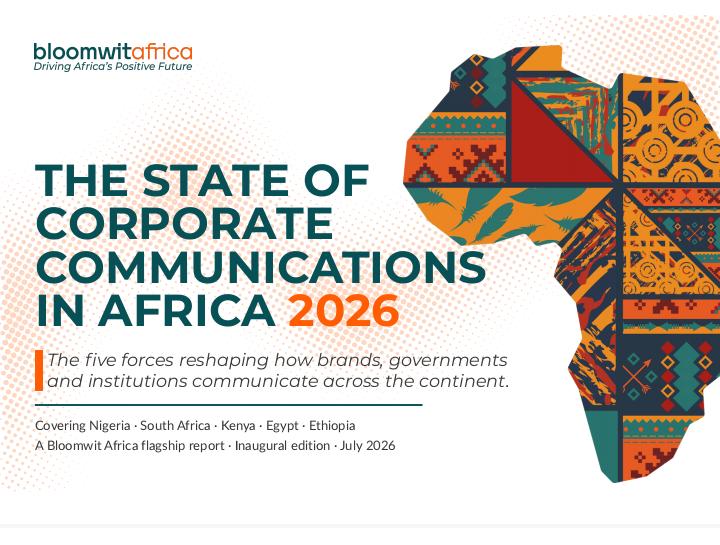
The growing use of artificial intelligence to create misinformation, coupled with the rapid shift of public conversations to closed digital platforms, is posing new challenges to corporate reputation and communication across Africa, a new report has warned.
The report, The State of Corporate Communications in Africa 2026, published by Bloomwit Africa, an independent public relations and advisory firm, says conventional communication monitoring systems are increasingly failing to capture conversations that shape public perceptions of organisations.
It identifies Nigeria, South Africa, Kenya, Egypt and Ethiopia as markets where communication patterns are rapidly evolving, with significant differences in preferred digital platforms, languages, media environments and public attitudes.
According to the report, WhatsApp has become a major channel for conversations across much of sub-Saharan Africa, while Facebook and Messenger dominate in Egypt and Telegram has significant influence in Ethiopia.
It cautions that organisations that rely on a single, continent-wide communication strategy risk missing critical conversations and misreading public sentiment.
Consequential conversations
“The most consequential conversations about your brand are now happening in rooms you cannot enter,” Oti Egwu, Executive Director of Bloomwit Africa, said.
She explained that by the time narratives became visible through conventional monitoring systems, they had often already gained traction and become difficult to change.
The report also identifies AI-generated misinformation as one of the most significant reputational threats facing organisations in 2026.
It notes that the creation of convincing deepfakes of corporate executives and fabricated company announcements has become faster and cheaper, while closed digital platforms provide an effective means of distributing such content.
Bloomwit Africa cited data from the Africa Center for Strategic Studies indicating that documented disinformation campaigns targeting African information systems have risen nearly fourfold since 2022, with at least 189 campaigns mapped so far.
The figure, according to researchers, is likely an undercount.
At the same time, the report says African audiences are becoming more discerning and demanding greater accountability from institutions and the media.
It cites Afrobarometer’s Round 10 survey, which involved 45,600 respondents across 38 African countries, showing that 72 per cent of respondents supported the media’s role in holding governments accountable, while 65 per cent supported the media’s right to publish without government control.
However, perceived media freedom declined by four percentage points across 30 countries surveyed, with Nigeria recording a 22-point decline.
The report argues that the changing media environment requires organisations to invest not only in technology but also in local expertise, authentic relationships, multilingual communication and crisis preparedness.
It highlights differences among the five markets studied.
Nigeria, with 109 million internet users, is described as a large and multilingual communications market where speed and scale are important. Egypt, with 98.2 million internet users and 82.7 per cent internet penetration, is predominantly Arabic-speaking and heavily Facebook-oriented.
South Africa is described as a more institutionally mature market where communication tactics are more likely to face public scrutiny, while Ethiopia has lower internet penetration but a strong preference for Telegram and an Amharic-language information environment.
Kenya, meanwhile, combines widespread use of messaging platforms with an active digital public and growing influence of TikTok.
The report projects that the communications gap between organisations with strong local capabilities and those relying on generic strategies will widen through 2027.
It predicts that closed digital channels could increasingly become the primary routes through which corporate crises escalate, while multilingual communication could shift from being a competitive advantage to a basic requirement.
Bloomwit Africa said the report was based on an analysis of publicly available third-party data on Africa’s digital, media and trust environment, interpreted through the firm’s advisory experience across the five markets.
The report also cites Reuters Institute and University of Oxford data showing average media trust of 44 per cent across 37 African countries.